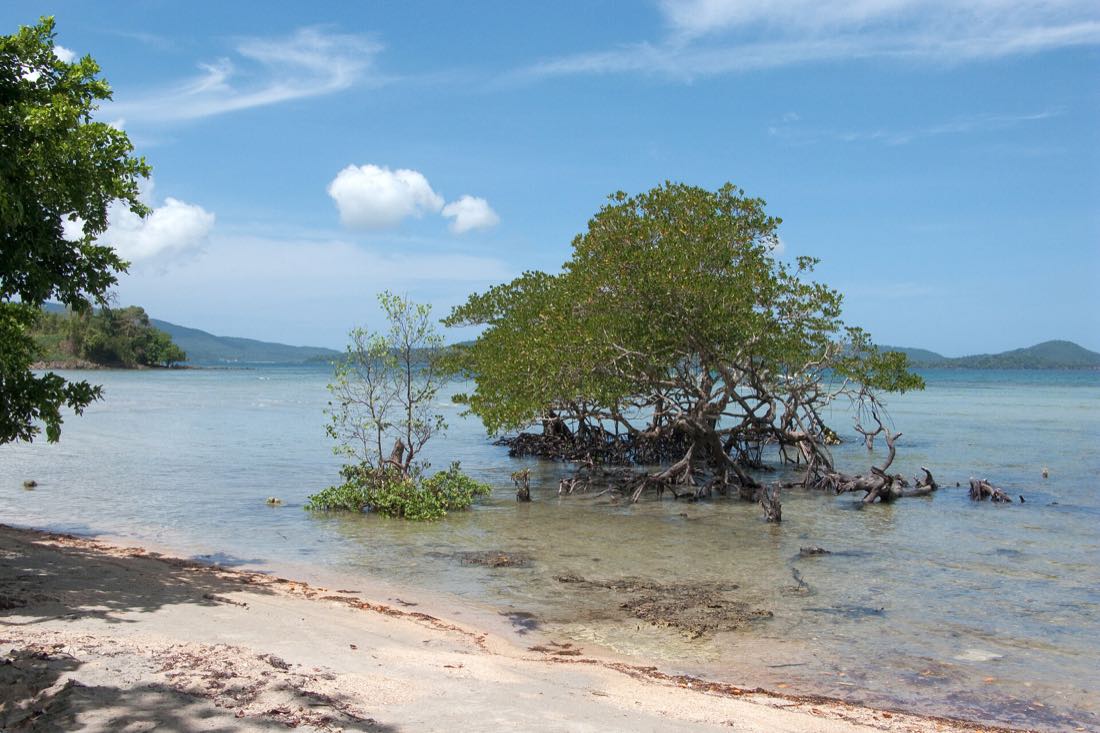
The Sabang mangrove paddle boat tour, reviewed
Yes, and it is the best value on the whole Sabang road. ₱200–350 (~$4–6) buys 30 to 45 minutes in an 8-seat paddle boat — no engine, no noise — up the Sabang River under century-old mangroves, a short walk from the wharf just past Daluyon. The guides sing: one of them, known as Lady Mangrove, performs her own mangrove ballad, and it is charming rather than excruciating. It rates 4.2/5 from 147 reviews and the one recurring complaint is fair — it is short for the money if you were expecting an expedition.
Half an hour of no engine
A wooden boat, a pole and a paddle, eight people, and a river roofed over by mangroves that have been there for a century.
The launch point is on the Sabang River a few minutes' walk from the wharf, just past Daluyon. Boats seat about 8 and are paddled rather than driven, which is the whole point — the trip is quiet enough to hear the birds and the water, and that is a genuinely different experience from everything else you do in a day full of outrigger engines and van air-conditioning.
You will be shown snakes in the branches — non-venomous tree snakes, coiled where the guides know to find them — along with kingfishers, crabs and, if you are unlucky with the tide, mostly mud. The guides are from the community and they run the commentary themselves. The famous one sings: Lady Mangrove has her own composition about the mangroves and performs it mid-river. Reviewers consistently name it as the best part.
It also takes 30 to 45 minutes, and that is the honest number. The most common criticism in the review corpus is that it is short for the money, which is a reasonable thing to say about ₱350 for half an hour and an unreasonable thing to be surprised by once somebody has told you. Now somebody has.
Tamilok, if you want it
Tamilok tasting is available here for anyone feeling brave, and it costs about ₱100 in Sabang against ₱150–300 in the city.
Worth getting the facts right before you decide, because almost every guide gets this wrong: tamilok is not a worm. It is a shipworm — a mollusc, a bivalve, a clam that lives inside waterlogged mangrove wood rather than in a shell. It is served raw in vinegar with onion and chilli, the texture is closer to oyster than anything else, and it is a real local food with a real history rather than a tourist stunt.
Take it or decline it without ceremony. The tamilok page has the full explanation, and Kinabuchs in the city has the best variety if you would rather try it with a cold San Miguel in front of you.
The three Sabang add-ons, side by side
You will have an afternoon in Sabang and three things to spend it on. They cost between ₱200 and ₱750 and they are completely different products — choose on what you want, not on price.
| Add-on | Price | Time | What you get | Verdict |
|---|---|---|---|---|
| Mangrove paddle boat 4.2/5 from 147 reviews | ₱200–350 ~$4–6 | 30–45 min | Quiet, shaded, no engine, guides who sing. The calmest and cheapest thing in the village. | WORTH IT |
| Sabang X Zipline ~4.5 from 227 reviews | ₱550–750 ~$10–13 | 15–30 min | 800 m across the cove at 150 ft, superman or seated. The view of Sabang Bay is the point. | DEPENDS |
| Ugong Rock caving and zipline 4.4–4.5★ from 664 reviews | ₱500–650 ~$9–11 | 1–1.5 h | A climb up through the inside of a 75 ft limestone tower. Not in Sabang — it is 20 minutes back down the road. | WORTH IT |
| All three, bundled with the river the structured day | $63–110 | 9–10 h | Klook's 3-in-1 is $63.69 at 4.5★ from 580 reviews with 8,000+ booked; the Ugong Rock builds run $74–110. | WORTH IT |
| Sabang Beach, and nothing 376 TripAdvisor reviews | Free | As long as you have | A long tawny strand that empties at 16:00. If your day has already been 9 hours, this is the correct choice. | WORTH IT |
Prices checked August 2026. The mangrove fee is community-collected and the exact 2026 figure is not published — ₱200–350 is the working band and ₱350 is the most-quoted single number.
The practical bit
Is it for you?
Bundle it or just walk up
The walk-up price is ₱200–350 in cash and nothing beats that, so a bundle buys you the certainty that the day includes it rather than a saving. Read every platform price against the local number.
Mangrove paddle questions, answered
How much is the Sabang mangrove paddle boat tour?
₱200–350 per person, roughly $4–6, paid in cash to the community operation. It is the cheapest paid activity in Sabang by a wide margin — the zipline next door is ₱550–750.
How long is the mangrove tour?
30 to 45 minutes on the water, about an hour once you have walked there from the wharf and waited for a boat. The most common complaint in its 147 reviews is that it is short for the money, which is fair and now expected.
Where does the mangrove paddle boat leave from?
The Sabang River, a 5-minute walk from Sabang wharf just past Daluyon Beach Resort. You do not need transport — if you are already in Sabang for the Underground River you can walk to it, which is not true of the ₱500–650 Ugong Rock stop 20 minutes back down the road.
Is the mangrove tour worth it?
Yes, at 4.2/5 from 147 reviews and ₱200–350. It is the only quiet thing in a day of engines and queues, the guides genuinely sing, and half an hour is exactly the amount of time you have spare after the cave.
Do the guides really sing?
Yes. One guide known as Lady Mangrove performs her own composition about the mangroves mid-river, and across 147 reviews people name it as the best part of the trip more often than they name the mangroves. It is 30–45 minutes and the singing is a meaningful fraction of it.
Can you eat tamilok on the mangrove tour?
Yes, tasting is available for about ₱100 in Sabang against ₱150–300 in the city. Tamilok is a shipworm — a bivalve mollusc that lives in waterlogged mangrove wood, served raw in vinegar. It is a real local food, not a stunt.
Does the mangrove tour run in the rain?
Usually. It is on a sheltered river rather than the open coast, so it survives conditions that stop the Underground River beach landing — which makes it the standard salvage plan for a cancelled morning across the 4 wettest months, June to September, when 219–246mm falls each month.