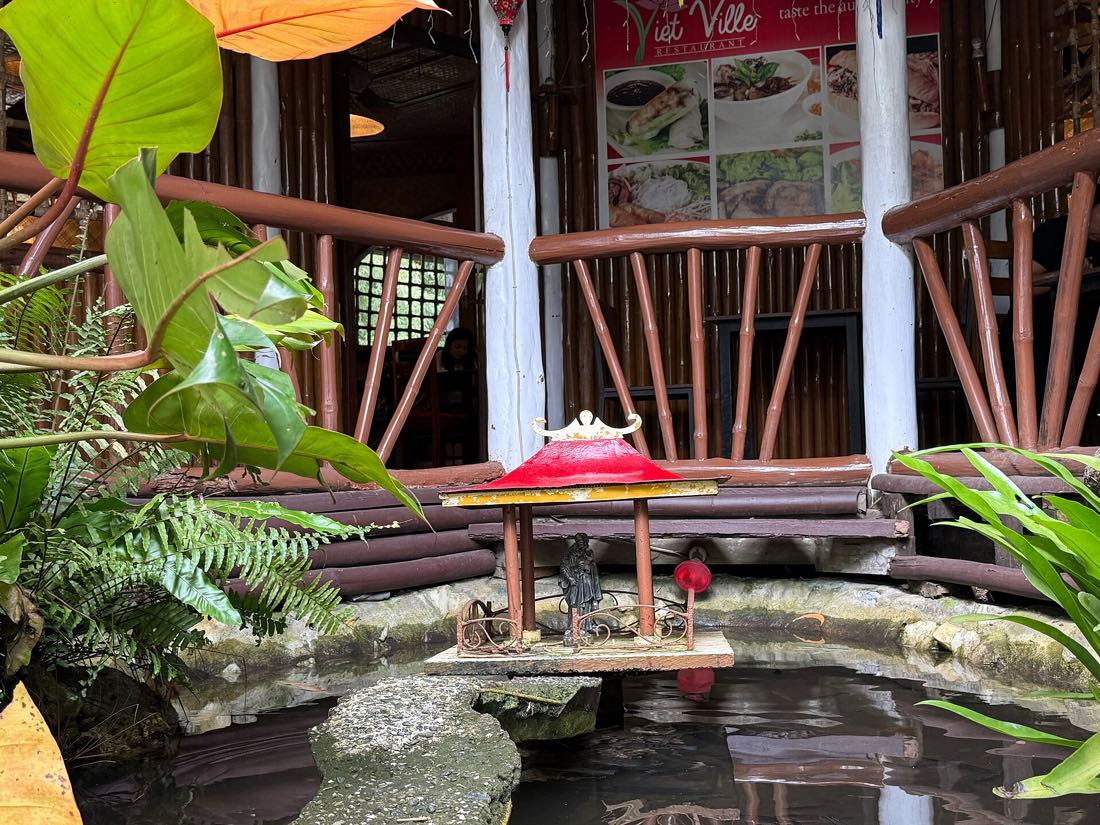
Viet Ville: pho in a half-empty refugee village
Go if the road takes you past it; do not build a morning around it. Viet Ville was built in 1985 for around 2,000 Vietnamese refugees — 13 hectares, about 200 homes, a Buddhist pagoda and a Catholic chapel. Most residents left for the United States, Canada and Australia in the early 2000s; by 2018 roughly five Vietnamese families remained. The village is visibly decaying and its sole operating business is the Viet Ville restaurant, where pho is ₱230 and banh mi starts at ₱135. Listed hours are 08:00–20:00 daily but they are unverified — confirm before you drive out.
A village that emptied, and one kitchen that did not
This is not a museum, a memorial or an attraction. It is a residential settlement that lost almost all its residents, with a restaurant in it. Go knowing that, and behave accordingly.
Viet Ville sits at Km 13, Brgy. Sta. Lourdes, on the road most tour vans take north towards the Honda Bay wharf and the Underground River. What you find is empty houses in various stages of collapse, overgrown lots, a Buddhist pagoda still standing, a Catholic chapel, and the restaurant — originally a refugee cooperative, now Filipino-managed with Vietnamese cooks.
The menu is short and the prices are honest for what they are: pho ₱230, banh mi from ₱135, chaolong ₱170, Vietnamese coffee ₱95 hot and ₱155 iced. That is roughly double what the same bowl costs at Bona's on Manalo Street, and you are paying for the setting rather than the cooking. Delivery into the city exists, which tells you how quiet the room can be.
A former refugee, quoted in reporting on the village, said of the restaurant's current broth: "There is no love in that broth." It is a hard line and it is the fairest single sentence about the place. The cooking is competent. What left with the families was not the recipe.
What it costs, against what the city charges
The comparison is the useful bit. Everything here is roughly double the city price for the same dish, and the difference is the reason you came.
| Dish | At Viet Ville | In the city | Verdict |
|---|---|---|---|
| Pho the real thing, not chaolong | ₱230 · ~$4 | Effectively unavailable — the city serves chaolong instead | WORTH IT |
| Chaolong the Palawan beef-stew version | ₱170 | ₱85 at Bona's, ₱60–120 citywide | SKIP |
| Banh mi | from ₱135 | Rare outside the chaolong houses' filled baguettes | WORTH IT |
| Vietnamese coffee | ₱95 hot · ₱155 iced | ₱50 at Bona's | DEPENDS |
Order the pho and the banh mi — the two things the city cannot give you. Ordering chaolong here at ₱170 when it is ₱85 downtown is the one avoidable mistake on the menu.
The practical bit
Forty years in six lines
The short version, because the long version is on the chaolong page where the food it produced is still being served.
After the fall of Saigon in 1975, Vietnamese boat people crossed the South China Sea and Palawan was the nearest Philippine landfall. In 1979 the Philippine government, UNHCR and the Catholic Church opened the Philippine First Asylum Center in Puerto Princesa. In 1985 a longer-term settlement went up at Km 13: 13 hectares, about 200 homes, a pagoda, a chapel, and noodle and bread workshops, holding roughly 2,000 people waiting for resettlement decisions.
Funding ended and the camp wound down through the late 1990s and early 2000s. Most residents went to the United States, Canada and Australia. Some married Palaweños and stayed. By 2018 only about five Vietnamese families were left in the village, which is the number every honest write-up of the place uses.
What survived the emigration was not the settlement but the food. Chaolong is now eaten across the city at ₱60–120 a bowl by people whose families never set foot in the camp. The village emptied; the dish did not.
Is Viet Ville for you?
The trips that pass the door
Nobody sells a Viet Ville tour. The way people actually get here is by asking a northbound driver to stop, so the useful bookings are the trips that already go this way.
Viet Ville questions, answered
Is Viet Ville worth visiting?
As a 45-minute stop on the way north to Honda Bay or the Underground River, yes. As a dedicated trip from the city — 13 km each way and a ₱300–500 tricycle charter for a bowl of pho — no. The village is semi-abandoned and the poignancy is the entire experience.
What is Viet Ville?
A settlement built in 1985 at Km 13, Brgy. Sta. Lourdes for Vietnamese refugees who arrived after 1975: 13 hectares, about 200 homes, a Buddhist pagoda and a Catholic chapel, housing roughly 2,000 people. Most residents resettled abroad in the early 2000s and about five Vietnamese families remained by 2018.
Is the Viet Ville restaurant still open?
Yes, and it is the only business still operating in the village. Listed hours are 08:00–20:00 daily with delivery, but we could not verify that for 2026 — treat it as a phone call to make before a 26 km round trip. Pho is ₱230 and banh mi starts at ₱135.
How do you get to Viet Ville from Puerto Princesa?
It is about 13 km north on the Sta. Lourdes road. Charter a tricycle for roughly ₱300–500 return with waiting time, or ask a Honda Bay driver to stop on the way back from the wharf. There is no Grab in this city, so agree the fare before you set off.
Is the food at Viet Ville good?
Competent, not remarkable, and roughly double the city price — chaolong is ₱170 here against ₱85 at Bona's. The pho at ₱230 is the reason to order, because it is the only proper Vietnamese pho in the area. A former refugee's line about the current broth, that there is no love in it, has stuck for a reason.
Can you look around the village itself?
Yes, along the roads and around the pagoda, which is still standing. People still live in a handful of the roughly 200 houses, so treat it as somebody's neighbourhood rather than a ruin: no walking into occupied lots, and ask before photographing anyone.
Is Viet Ville the same as the chaolong story?
It is the same history, split in two. The village is where the refugees were housed from 1985; chaolong at ₱60–120 a bowl is what their cooking became once it spread into the city. The village emptied and the dish did not.
Verify the hours, because there is no plan B at Km 13
Puerto Princesa's restaurant scene turns over fast and most guides do not keep up. Gypsy's Lair and La Terrasse are closed, and KaLui's old official domain now resolves to a gambling site — competing guides still link it. Where a place could not be confirmed open from a 2024–2026 source, this site says so instead of guessing.
This is the page on this site where an unverified opening time costs the most: it is a 26 km round trip and there is no second restaurant out there. The 08:00–20:00 listing is what the restaurant publishes; nothing we could check confirms it is current for 2026. Call ahead, or make it a stop on a day you were driving north anyway, and the risk disappears entirely.
Grab does not operate in Puerto Princesa. Not reduced, not patchy — absent. Guides that tell you to just grab a Grab from the airport were written from a desk. Ride-hailing firms have been reported as eyeing the city and none had filed for a franchise at the last check, so treat any app that does show cars as a bonus. The system here is the tricycle: ₱15–25 a hop shared, ₱100–150 to charter the whole thing from the airport into town. Agree the fare before you get in and you will never have a problem.